
Enhanced Services: "WAP," "OOF," "POW"
Superpower struggles set the stage for the future of WAP and wireless Internet applications.
By Phyllis Huster, Telcordia Technologies

Photo courtesy of Warner Brothers, www.batmantas.com.
The word WAP conjures up images of old Batman episodes, where the villains end up duking it out with the superheroes, uttering expletives such as "WAP" and "POW." The Batman analogy aptly describes current superpower battles such as UK-based Vodafone's takeover bid of Germany-based Mannesmann. The takeover is estimated to be worth $180 billion and double-digit millions of wireless customers, as well as the title of "Global Wireless SuperCarrier".
According to Tomas Duffy, CEO of Mannesmann ipulsys B.V., "WAP is key for delivering data to wireless customers, and Mannesmann ipulsys has built a high-bandwidth pan-European IP network to facilitate our partners' transmission of both wireless- and wireline-originated data. ipulsys understands the importance of WAP data standards as critical to the future of all wireless providers, and the company is strategically well-positioned to facilitate data transmission over its global IP network."
What's becoming critical for wireless carriers is increasing airtime, preventing customer churn, and preserving astronomical growth (with CAGR projected at 200% in some wireless markets). AT&T is so confident in the growth of its wireless division that it is spawning a tracking stock so that investor capitalization could fuel its rampant growth. Enhanced data services such as Internet Web browsing, unified messaging, e-mail, customized content, and IP Fax have become the Holy Grail of customer retention and every provider's goal. Carriers are hoping that WAP will make enhanced data and Internet services possible and simple for wireless customers. What's critical to customers are three main services: Wireless Web browsing, e-mail (with attachments), and pulling content customized to the user.
WAP's World
The architecture for WAP is straightforward (see figure), basically inserting itself as a gateway between the HTML content world and the world of wireless devices. It provides three broad categories of functionality for content providers: content, scripting, and telephony. The future may see different kinds of service providers attacking each of the three functions separately, leaving wireless carriers to stay focused on telephony and content providers to focus on scripting and content.
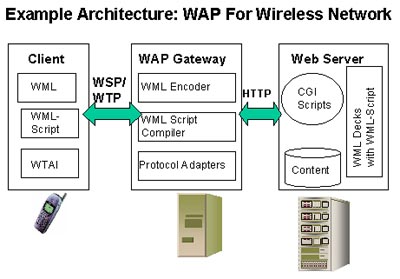
Source: WAP Forum Presentation 1999
Partnerships are necessary for wireless carriers to have successful wireless Web offerings. Examples include Sprint's partnership with Yahoo for content and Palm.net with Mapquest for wireless location information. WAP also defines a scripting language, Wireless Markup Language (WML) Script, which is similar in concept and purpose to JavaScript for HTML. WML Script is often stored in its own file and, using the concept of "cards" and "decks," executes functions that verify input fields or that convey limited state information.
Today's Services
Sprint's Wireless Web uses phones with a screen that allows access to limited Web content formatted to be readable and usable to Internet users. Sprint is the early leader in WAP-based applications, getting this Web browsing-capable handset to market ahead of other U.S. carriers. WAP handsets, though currently cumbersome for data entry because of the 10-key touchpad, will eventually grow into providing full palmtop and even full keyboard functions for Web surfing capabilities over time. The early leaders are already grabbing the customer's "walletshare," making deployment of enhanced services a "do it now" imperative for other wireless providers unable to risk being a late entrant in the hottest wireless service offering for the next decade.
Carriers are considering the following WAP applications: Web browsing of popular content Web sites (i.e. stock quote sites friendly to wireless surfers), access to a person's corporate firewall (i.e. Lotus Mail), and customized airline or travel booking applications. However, most data needs can also be satisfied by intelligent SMS messages in the short-term. Until the WAP handset screens get larger, some Web benefits, such as graphic stock charts or e-mail attachments, will not be practical for users of handheld devices.
Current WAP handsets are excellent for receiving data but are unfriendly for delivering it. Although analysts predict WAP handsets will comprise one third of all handsets shipped by 2005, the form factor and design must meet user needs while keeping the "slimline" appeal that they demand. Long term, analysts predict the WAP handset will begin eating into the PDA and palmtop markets, continually improving upon size of screen, weight, and feature/functionality tradeoffs.
Value Proposition
WAP continues to become a strategic part of wireless' future, just as the Internet has become for business today. However, companies need to think about what the value is for the customer. The trends driving users to wireless Internet access are interest in commerce sites (Amazon.com), access to messaging in all forms (e-mail, voice mail, fax), and access to news/entertainment (msnbc.com or Hotmail's myportfolio for stock updates).
The value is having access to these things while traveling or in mobile situations (office conference rooms). Until carriers fully understand customer needs, it's not clear that WAP content development will be anything but misguided. For example, this summer I bought a Nokia Communicator 9000, with full Web, keyboard and e-mail capabilities. Although it was not WAP-enabled, it had sophisticated functionality for Web browsing. I found traveling throughout Switzerland, Austria, and England seamless and surprisingly easy.
However, even given the top-of-the-line phone, there were only three things I wanted with the Web capability: access to my free Web Hotmail account (which had my unified messaging features of voice mail and faxes formatted as e-mails); access to my four critical stocks (which were cumbersome to view because those pages were not formatted for wireless); and the ability to use Mapquest for finding directions.
The barrier to a positive wireless Web experience was the lack of Web sites that were wireless-friendly without being too limited by being WAP-enabled. Yahoo has found this balance by making its data partially available on the SprintPCS phone. Mapquest has also addressed this need and is available on the Palm.net service for the PalmPilot. Over time, other popular Web sites must prepare for wireless audiences and start WAP-enabled development of their sites. Until bandwidth-expanding upgrades to carrier networks such as 3G wireless are fully adopted, WAP-enabled handsets may be Porsches waiting for the one lane road to grow into a superhighway.
Money Talks
However, the real question is how WAP development efforts will compete for R&D budget against network upgrades to bandwidth-expansion projects, such as 3G wireless technologies. Because voice airtime usage is 98% of a carrier's revenue source, technologies facilitating calling are probably the first contenders of how the budget gets spent. These are the financial and business challenges facing wireless carriers, which are being asked both to expand the network OSI layers 1-4 and at the same time focus on enhanced services (OSI layers 5-7).
Outsourcing
One answer is outsourcing enhanced applications. For example, Germany-based Marterna Information and Communications dispatches more than 200 million SMS messages per month and offers wireless carriers an extensive outsourcing alternative for WAP and SMS services. The average worldwide price for sending an SMS message averages 10 cents per message, according to industry analyst Simon Buckingham of Mobile Lifestreams Ltd. For this reason, SMS and WAP are both becoming new transaction-based revenue streams that carriers are investigating as an on-ramp to wireless commerce offerings.
This data and content outsourcing trend not only is likely to continue but also could spawn a new industry of virtual wireless content providers focused on niche content offerings (i.e. wireless real-time stock feeds or wireless location-tracking services). This allows carriers to focus on reception, roaming fees, and wider coverage areas.
Besides Saraide and Wireless Knowledge, there are relatively few "large" content providers servicing the wireless market. With outsourcers such as USA.net winning large corporate e-mail customers, the question remains which companies will focus on the outsourced application needs of a wireless handset user? Wireless carriers and content providers are emerging niche industries and represent the most exciting near-term future of WAP, and companies funding it for the pure advancement of enhanced services will succeed in that focus on software development vs. network build-out.
The challenge for wireless carriers is close partnerships with content providers to deploy such services to large wireless audiences. Clearly, WAP offerings are not for the faint of heart, and those who get it right may claim customer retention and the corresponding revenues that result from increased airtime and a churn-proof customer base in these days of fleeting customer loyalty.
About the Author
 Phyllis Huster is director of edge development, Convergent Solutions Practice, Telcordia Technologies. She has more than five years experience in the Internet, focusing on the Application Outsourcing, Unified Messaging, Managed Messaging, Fax over IP, and Voice over IP markets. She is currently responsible for finding edge technology vendors and assessing whether SAIC/Telcordia should invest, partner, VAR, or OEM such technologies. She is involved in helping set Telcordia's strategy for VOIP, Unified Messaging, DSL, and Wireless markets.
Huster has provided consulting and seminars to International carriers such as Cable & Wireless, Belgacom, Frontier/Global Crossing, and Mannesman Ipulsys. She also works with Telcordia's Consumer Internet Device, Wireless and Screenphone practice to create sales opportunities. She has previously served as a board member at DotOne Inc. (Acquired by Critical Path in July 1999). She can be reached at phuster@telcordia.com.