
Two Apps Allow Carriers to Enhance Customers' Access to Messages, Internet
The new applications, Internet Message Management and Voice Browser, are based on Lucent's new Mobile Communications System (MCS). With MCS, carriers can offer their customers greater control over the information they receive. For example, people can monitor the performance of their personal investment portfolios, "voice surf" the Internet for local restaurant or lodging recommendations, and receive and respond to messages while on the go, via voice commands and data messages on their telephones.
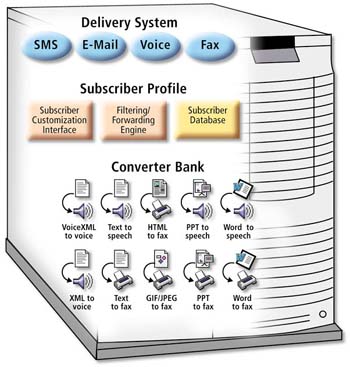
Message Management
With the Internet Message Management application, subscriber-controlled filtering rules enable users to define what messages they receive on which communications devices and at what time. For example, a user can program the application to only deliver messages from their administrator and manager.
This application also allows mobile users to receive e-mail messages with attachments, such as voice files, Microsoft PowerPoint presentations, or Lotus Word Pro documents. These attachments can either be converted into speech and listened to over a wireless handset, or redirected to a fax machine that is convenient for the user.
Using text-to-speech technology, fax capabilities, and wireless data transmission, Internet Message Management allows e-mail to be displayed on wireless handsets or converted to voice for delivery over phone lines or to images for delivery to fax machines. This application also uses two-way short message service (SMS) in a wireless environment and will expand to include support for the Wireless Application Protocol (WAP), making it possible to use on current and next-generation mobile phones.
Speech Commands
Voice Browser allows mobile users to access personalized Web sites over the phone using voice-recognition software. By using voice commands, a user can navigate and obtain customized information, such as stock quotes, daily schedule, traffic and weather reports, phone directories, and local news. Lucent's text-to-speech technology makes it possible to convert textual information from the Internet into voice.
MCS enables service providers to increase revenues and reduce subscriber turnover. Service providers also can take advantage of new opportunities by tapping into Internet revenue streams, such as online advertising and e-commerce.
The MCS uses speech technology from Lucent Speech Solutions. Combined with Lucent's patented speech software, the compact PCI speech processing board supports open interfaces and handles multiple languages.
Availability
The Internet Message Management application was developed in Bell Labs and will be available to wireless, wireline, and Internet service providers in North America, Europe, and Asia in the third quarter of 2000 in U.S. English. Future languages include U.K. English, German, and French. Initial installations of the Voice Browser application will begin in North America in the second quarter of 2000.